

There is a specific kind of morning person I am not, and it is the one who deals well with the sound of glass grinding against porcelain at 7:00 AM. Last Tuesday, I stepped into the shower, gave the door a gentle pull, and—skreeeeee. My beautiful heavy glass door was digging a literal trench into my floor. It is a gut-wrenching sound, isn’t it? You immediately start calculating the cost of a new door, or worse, a full shower renovation. I stood there, towel in hand, wondering if the whole thing was about to shatter into a million tiny diamonds. It is terrifying, annoying, and surprisingly common.
Stop the Screeching Before You Crack a Tile
I have spent years tinkering with flooring installation and bathroom hardware, yet I still managed to make a rookie mistake when this first happened to me. I thought the house was settling. I actually spent three hours trying to level a subfloor dip nearby before realizing the floor was not the problem at all. It was the hinges. If your door is dragging, you are likely facing a hardware failure or a minor structural shift, and ignoring it is a recipe for a very expensive explosion. Today, I am going to walk you through exactly why this happens and how you can realign that door yourself. We are going to save your tile, your glass, and your sanity. Have you ever felt that moment of pure panic when a door just will not close right?
Is This Actually a DIY Fix or a Disaster Waiting to Happen?
I get it. Working with heavy tempered glass is terrifying. You might be thinking that if you touch those screws, the whole thing will implode. It is a valid fear. According to the National Glass Association, tempered glass is designed to be incredibly strong on its face but remarkably fragile at its edges. One wrong move with a dragging door can hit that sweet spot on the edge and cause a total failure. But here is the secret: most of the time, the fix is just a matter of physics and patience. I have seen homeowners go through the stress of shower repairs only to realize a simple adjustment was all they needed. Often, the issue is simply that your shower glass door hinge is pulling out, and we can fix that before it ruins your morning routine again.
Reset Your Door Without Breaking the Bank
Before you touch a screwdriver, grab a pack of composite shims or a helper. You cannot safely align a 50-pound slab of glass while it is hanging mid-air. I remember trying to adjust a heavy pivot door in a cramped guest bath once; I thought I could just nudge it with my shoulder while tightening the plate. One tiny slip later, and I was staring at a deep gouge in the floor that eventually required a specialized guide on how to repair a chipped ceramic tile in a shower. Now, I always slide shims under the door until the height is perfect and the top of the door is level with the fixed panel. This removes the weight from the hinges so you can actually work on the hardware without the glass fighting you. It is the same principle as using the spacer block move for perfect tile alignment—you need a solid foundation before you commit to the final position.
The Secret is in the Hinge Gaskets
Once the weight is supported by your shims, loosen the screws on the hinge plates just enough to see the internal gaskets. If your door is dragging, it is usually because these little rubber or plastic pieces have lost their ‘bite’ due to age or soap buildup. It is strikingly similar to how the pressure sensitive glue rule for vinyl tile works; you need the right surface tension for things to stay put. I like to wipe the glass and the gaskets with a bit of rubbing alcohol to remove any slippery residue. This creates a clean, high-friction surface that prevents the glass from sliding down like a slow-motion landslide. If the gaskets are cracked or paper-thin, do not try to MacGyver it with tape; get replacements to ensure the door stays where you put it. 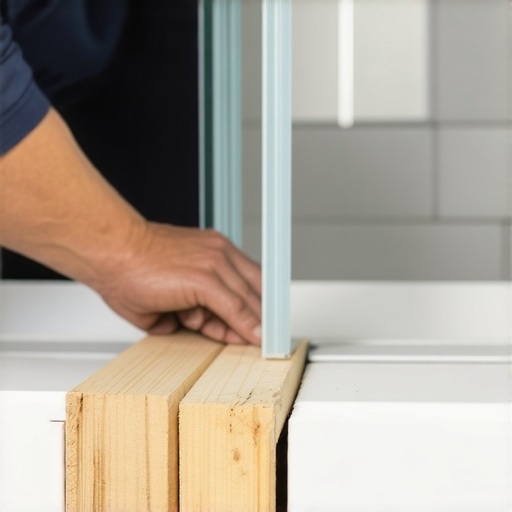
Tighten Down Without Creating a Stress Crack
Now comes the delicate part: securing the plates. You want them tight, but you are not trying to crush the glass into dust. Think of it like carpet install secrets—precision and even tension matter more than brute force. Use a manual screwdriver, never an impact driver. An impact driver is far too violent for this task and can shatter tempered glass in a heartbeat if it hits a resonant frequency or over-torques a single point. Tighten the screws in a cross pattern, much like you would the lug nuts on a car tire, to ensure even pressure across the entire hinge plate. While you are down there, check the surrounding area for structural integrity. Sometimes a dragging door is just a symptom of a bouncy subfloor that is causing the wall or the transition strip move for carpet to bathroom tile to flex and shift.
Check Your Clearances and Plastic Seals
After tightening, remove your shims and swing the door slowly. You should have a consistent, uniform gap at the bottom. If you still see the door dipping near the handle side, you might need to adjust the ’tilt’ by slightly loosening the top hinge while the bottom remains seated. It is a game of millimeters. While you are inspecting the clearance, take a look at your bottom sweep. A worn-out or calcified sweep can catch on the shower curb slope and make it feel like the door is dragging even if the hinges are perfect. Replacing a cheap plastic sweep is much easier and cheaper than dealing with the aftermath of ignored shower repairs that stemmed from water leaking onto your bathroom subfloor.Many DIYers assume that if a door drags, you just need to crank down the screws until they can’t turn anymore. This is a dangerous myth. In my years of handling shower repairs, I have seen more glass shattered by over-tightening than by accidental bumps. The Glass Association of North America (GANA) notes that localized stress from over-torqued hardware is a primary cause of spontaneous breakage in tempered panels. If you are fighting the same drag every few months, the hardware isn’t the problem—it’s the lack of structural blocking behind your tile.
Why Does My Hinge Keep Loosening No Matter How Much I Tighten It?
This is the ‘oops’ factor that kills many shower renovation projects. If your installer didn’t double up the 2x4s behind the wall where the hinges sit, you are essentially hanging a 60-pound weight on a thin sheet of tile and backer board. The weight causes the wall to flex minutely every time you open the door, eventually stripping the screw holes or cracking the grout. I always recommend checking for ‘wall-pant’—where the wall moves when you push against it. If your wall has a heartbeat, no amount of hinge-fiddling will save you. You might even find that your shower glass door hinge is pulling out because it has nothing solid to bite into. Plastic anchors are the biggest trap here; they are great for a towel bar, but they have no business holding a glass door. Even a high-end linear drain secret for modern walk-in showers won’t make a bathroom feel luxury if your glass is constantly threatening to sag. 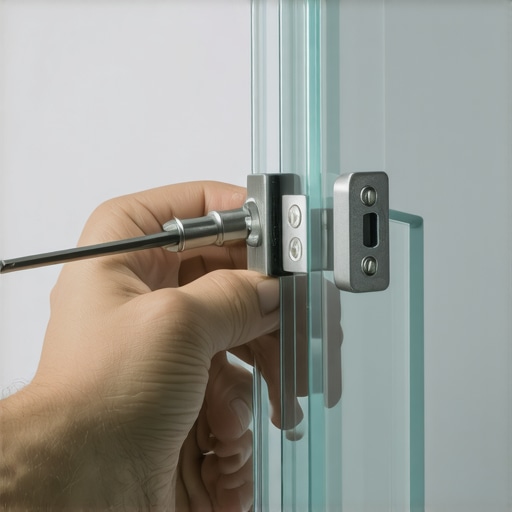
Forget the Level and Use Your Eyes Instead
Here is a contrarian take: stop obsessing over your bubble level. While the laser level move for perfectly horizontal shower tiles is vital for the initial layout, doors live in a world of ‘visual square.’ If your dry pack secret for rock-solid shower subbases resulted in a slightly sloped curb for drainage, a perfectly level door might look crooked against the floor line. You want to align the door to the *fixed* panel and the *curb*, not necessarily to the center of the earth. I have seen homeowners tear out perfectly good work because they were chasing a level line that didn’t match the reality of their home’s natural settling. It is the same logic we use when applying the thinset comb secret for preventing tile lippage—you are managing the transition between two surfaces, not just following a tool. If it swings smoothly and the gaps are even, you have won. This is similar to why the inside corner cope for perfect baseboard installs is better than a miter; it accounts for real-world walls that aren’t actually 90 degrees. Have you ever fallen into this trap of chasing perfection only to realize the house had other plans? Let me know in the comments.
I have realized over the years that the difference between a DIYer who fixes things once and a pro who never has to come back is the gear in their bag. If you are still using that rusted, generic screwdriver from a kitchen drawer, you are asking to strip your hinge screws. I personally swear by a set of Wera Kraftform screwdrivers because the laser-tipped drive bites into the screw head like a pit bull. When you are dealing with the high-tension environment of a shower repair, the last thing you want is a tool that slips and gouges your hardware or, heaven forbid, the glass itself. It is the same reason I use specialized cutters for a flooring installation; precision tools prevent the small errors that lead to big failures later on.
Invest in These Non-Negotiable Tools
Beyond the screwdriver, you need a high-quality moisture meter. I don’t care if you are just checking the wall behind your hinges or prepping for durable flooring installation. The Tramex MEP is my go-to because it is non-destructive. If your hinges keep sagging, use the meter to see if there is a hidden leak behind the tile. Moisture softens the wooden blocking, causing the screws to pull out. This is a technical requirement often cited in the Tile Council of North America (TCNA) Handbook, which emphasizes that substrate deflection (the L/360 standard) and moisture content are the primary killers of tile integrity. If the wall is wet, no hinge in the world will stay straight.

How do I keep my shower door from sagging again?
Maintenance is not a ‘once-and-done’ event; it is a seasonal rhythm. Every six months, I recommend doing a ‘torque check.’ Open your door halfway and give it a very gentle tug upward. If you feel even a millimeter of play, it is time to support the door with shims and re-snug those plates. While you are at it, check your baseboards nearby. If you see the caulk line where the baseboard meets the floor starting to pull away, it is a sign that your subfloor might be shifting, which directly impacts the squareness of your shower opening. I always keep a bottle of blue Loctite (the removable kind) in my kit. Applying a tiny drop to the hinge screws provides a vibration-resistant bond that stops the creeping sag caused by the constant swinging of heavy glass.
The Future of Smart Bathroom Maintenance
I predict that in the next five years, we are going to see ‘smart hinges’ integrated into modern bathroom makeovers. We are already seeing sensors in high-end commercial spaces that alert facility managers when a door is out of alignment or when moisture is detected behind a wall. For now, you are the sensor. Paying attention to the small sounds—the tiny click when a hinge resets or the way a staircase nose might creak—is your best defense. If you want to really level up your DIY game, try my favorite advanced tip: use the masking tape trick not just for silicone, but to mark the exact position of your hinges on the glass. If the glass moves even a hair, the gap in the tape will tell you before the door starts dragging.
What Nobody Tells You About the Sound of Grinding Glass
After years of tackling upgrade your bathroom: the ultimate shower renovation guide projects, I have realized that glass doors are living things—they move, breathe, and occasionally try to escape their hinges. One lightbulb moment for me was realizing that gravity isn’t the only enemy; it is the soap scum that acts like a lubricant between the gasket and the glass. I also learned the hard way that ‘tight enough’ usually means stopping exactly two seconds before you feel the urge to grunt. If you are struggling with a door that just won’t stay put, remember that cleaning the glass with alcohol before resetting the hinge is worth more than ten extra turns of a screw. It is about friction, not just force.
Gear That Saves My Hands and Your Glass
You do not need a truck full of tools to finish this, but the right ones make you feel like a pro instead of a nervous wreck. I always recommend Wera Kraftform screwdrivers because their laser-etched tips prevent the slipping that leads to scratched hardware. For those aiming for a creating a spa-like shower experience, keep a set of composite shims in your drawer; they don’t swell with water like wood and provide the perfect lift. I also never finish a hinge reset without a tiny drop of blue Loctite on the threads to fight the vibration of daily use. Finally, if you are unsure about the state of your walls, a non-destructive moisture meter is the only way to know if your transform your home: expert flooring installation tips for 2025 plans are about to be interrupted by a leak.
Reclaiming Your Spa Instead of Managing a Job Site
Fixing a dragging door is about more than just stopping a noise; it is about protecting the investment you made in your home. Whether you are in the middle of a DIY project or planning a professional shower renovation, small adjustments today prevent the heartbreak of shattered glass tomorrow. Once you have that door swinging smoothly, you can finally go back to enjoying your morning without that gut-wrenching screech. Don’t forget to use the bead and smooth strategy for shower corners to keep everything watertight while you are at it. You’ve got this!
Have you ever heard that terrifying ‘skreeeee’ sound and just closed your eyes, hoping the door wouldn’t shatter? Tell me your shower horror stories or the weirdest fix you have tried in the comments below!